Monday, August 10, 2015

Three Romances - It Happened One Night, A Husband's Wicked Ways, & More than a Mistress

These are not part of my challenge, but sometimes, you just want to read what you want to read.  I found the first two of these recently, and gave them a try.  It Happened One Night is a set of four short stories, each by different authors.  The lead story is a Stephanie Laurens one, an author I've read a lot of.  The other three are new to me.  These were all kind of okay - not great, but not horrible.  Which is nice when horrible quality is pretty common in this genre.  I think the last story might actually be my favorite, because it's the most unusual of the bunch.


I found A Husband's Wicked Ways on the bookshelf at work.  We maintain a borrowing library, more or less, there.  The plot line, involving the Napoleonic Wars and spy work, reminded me of a few of Stephanie Laurens' works so I gave it a shot and ended up enjoying it quite a bit.  It's the third in a trilogy so it would have been better to start at the beginning, but it didn't hurt to read this one first.  My only complaint is that the ... ummm ... more romantic parts of the book are just cold and weird, despite the banter between the two leads normally being snappy, entertaining, and warm.  it's a strange juxtaposition.  And the master spy ends up being not so bright toward the end.      

I have had More than a Mistress for a while now, and decided to polish it off, too. I think I liked this one the most of the three.  A lot of the typical plot points are hit, but the "hero" is a little less annoying than usual, and the pot shots that the two lead characters take at each other are pretty humorous.  

Final call:


Three stars to all.

These are pretty decent if you like Regency-era historical romances.  The plots are all a bit contrived, but how could they not be?  People didn't act like this then!

Sunday, August 9, 2015

Orange & Yellow - Getting Started With Butterflies

Not too long after our return from Ireland, we went back to Fulton County to do some work at the farm, and also just to visit and enjoy some time in the country.  My Dad planted a wildflower patch at the farm that was in full swing in mid-June, attracting mostly fritillaries but also a few other winged denizens.


This is a Great Spangled Fritillary, or an Aphrodite, but I'm not sure which as they're very similar and I'm a little too lazy to get out the ID guide right now.


There was one Black Swallowtail in the patch.  These are striking, when most of the other colors in the vicinity are yellow, orange, and green.  The last type of butterfly I managed to get a still shot of was this guy, which I believe is some sort of sulphur, possibly a Clouded Sulphur.


Here's a wider shot, where you can see the bold blooms pulling these guys in, plus two more fritillary/aphrodite types.  I think there were 10 or more at any given time in this patch!


I called this post "Getting Started With Butterflies,"  because we have managed to have quite a few adventures with butterflies lately, and this is just the first one!


Saturday, August 8, 2015

The Anubis Gates

I do know how this book made it on to my list   I saw an article about the origins of steampunk and it included this title, saying that it's also one of the best science-fiction books around.  Then I found it at a library book sale.  Done, and done!  Since I feel like I have a lot of random thoughts about it, let's just do a bulleted list:
  • The Anubis Gates reminded me of a book from earlier this year, Drood.  That book also has Egyptian cults and lots of subterranean London action, so maybe it's not so surprising.  Both books were also on the Dickensian side of things, although at least in The Anubis Gates, Dickens himself is not a character!
  • This is one of the just plain cleverest books I've gotten my hands on.  The plot zips in and around and over itself perfectly.  There are layers and layers behind what's happening and why.
  • The mystery of William Ashbless is a hoot.  You figure it out pretty quickly, but then find out that you really didn't know everything after all.
  • The ending is just fantastic.  One of the more perfect ones I've come across lately.
  • The part that happens in actual Egypt sticks out like a sore thumb from the rest of the book but it's one of the best parts.  So is the trip back to the 1600s.
  • When the book tips over into the horror side of things, it gets really horrific.  The idea of a body-switching werewolf is especially terrifying, not to mention an evil clown on stilts.
  • Who knew Samuel Taylor Coleridge had it in him!
  • This is one of the earliest examples of steampunk, and it's really interesting to compare it to the genre now.  For instance, aside from magic/sorcery/time travel, there really isn't much in the way of alternative history, or steam-driven technologies that didn't exist at the time.  No dirigibles, no protagonists running around with aviator goggles.  No people with mechanical eyes or other body parts.  But the atmosphere is there, for sure.  The high action, the humor, the tongue-in-cheek feel to the plots you sometimes get.  It also reminds me very much of the Parasol Protectorate books, minus the technological fancies.
  • It's really wordy!  I found a long paragraph that was actually one sentence!
Final call:
I'd give this book the time of day, any day.  And I don't think you have to be a sci-fi or fantasy nut to enjoy it. 


Friday, August 7, 2015

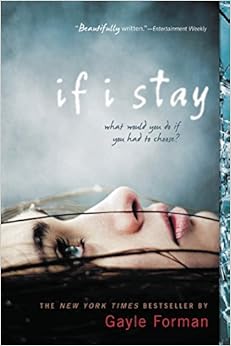
If I Stay

I'm not sure how this book got onto my list, except that sometimes I do like to dip into the Young Adult section of the bookstore.  There are some great quality books there.  

This one is fine.  The plot turns around 17-year old Mia, and whether she'll decide to stay here on earth and live, or move on and die, after she is grievously injured in a car accident that kills the rest of her immediate family.  She's essentially having an out-of-body experience for the bulk of the book.  There are a lot of flashbacks to moments with her family and boyfriend.  Everyone is actually pretty well-adjusted and pleasant.  

There's a lot less ruminating over the meaning of life and the loss of it than I expected, and more of it centers around her boyfriend than I expected.  It's a very short book.  

What bothered me the most is probably pretty minor.  We can't just have Mia, who plays the cello, and Adam, who plays in band.  It has to be Mia, the best cellist Oregon has ever produced, and Adam, whose band is on the verge of making it big.  I think the book would have been more powerful if the characters had been a little less exceptional.  Similar to my complaint about Bel Canto.  With all these super fantastic people running around, the whole thing becomes a little less believable.    
   

Final call:
 Is this a powerhouse?  No, but it's a lot better than some of the mindless crap that's out there for teens!


Thursday, August 6, 2015

Wicked Plants

This may rank as "The Book I Own With the Oddest Backstory."  I was visiting a local thrift shop and saw this on their shelves.  I have Stewart's The Drunken Botanist so I picked it up, and was quickly fascinated with the artwork inside.  When I went to check out, the owner told me the book was free, because a landlord had called her in to clear out the apartment of a drug dealer and she had found it there.  We both thought it was strangely appropriate, but verging on scary, for a drug dealer to have a reference book on poisonous plants!

This is a small book, with a lot of illustrations.  It won't take you long to read through it.  I picked off chapters here and there before bed and on car rides, and really enjoyed it.  There's not a lot of detail, and sometimes you want more information, but overall it's an entertaining work and not meant to be encyclopedic.  Some of the gruesome illustrations are silly, but the full page etchings of plants are gorgeous.  Many of them almost look fossilized.  I'll paste one in so you can see what I mean.


Final call:
 Lightweight and entertaining.  I'm seriously considering pulling out a few of the illustrations and framing them.


Wednesday, August 5, 2015

Irish Details - Dublin Part 3

Our last day in Ireland was spent hoofing it around town, catching a few things I'd seen before and a few new things, too.  All in all, a great day.

Our first stop was Trinity College, which has both the Book of Kells (an elaborately illuminated medieval copy of the Gospels) and the spectacular Old Library.  This is a panoramic shot of the inside of the Old Library.  Yes, that's two stories of floor to ceiling book shelves in ornate galleries.


Next up was a visit to the National Museum, which houses archaeological finds from all over the island.  Jewel-encrusted was a common descriptor :)


Then, a nice walk through two big public open spaces:  St. Stephen's Green and Merrion Square.  These are Mute Swans in the ponds at St. Stephen's.


The day also included traipsing through residential neighborhoods with the fancy Georgian doorways the city is so known for.


We ended the walking tour with a trip to the Chester Beatty Museum, located in Dublin Castle.  The Castle is a big sprawling office complex, of which only a small part looks anything like a castle.


I couldn't take pictures inside the museum here, but it was fantastic.  Chester Beatty collected early manuscripts and illuminated scrolls from around the world.  There are amazing exhibits on Japanese birds & flowers art, early copies of the Quran, fragments of early Bible texts, and so much more.


I could take pictures of the park-like Oriental Gardens inside the Castle walls.  Later this night, we decided to simply visit a supermarket and make a picnic dinner for our last meal in Dublin.  A nice thing about the city is that little and big markets are within walking distance, and prices are really no different than I would expect in the stores I normally shop at here.


We were able to pull this together for about 20 Euros, including some beverages.  A very nice way to end the day, and the trip!


Tuesday, August 4, 2015

A God in Ruins

Let's take a step back.  This book follows Teddy, Ursula's brother, from Life After Life.  In that book, Ursula lives many many versions of her own life, beginning and culminating in an attempt to assassinate Hitler, possibly in hopes of preventing WWII and her brother Teddy's death.  At the end, she accomplishes this but is born yet again.

Teddy doesn't have multiple lives, just the one he thought he wouldn't have.  As a bomber pilot in the war, he had to assume he'd never make it home.

My personal interpretation of both books goes like this:  Ursula was "meant" to die at birth, but rebooted and continued through her iterations to a life where she could try to prevent WWII.  However, despite the Hitler assassination attempt, it was still a world where Teddy died.  Therefore, when she was reborn again, her mother (who was particularly fond of Teddy) was prepared and prevented the infant Ursula's death, which sent her through all the motions again, to make a world where Teddy survived.

What we see in A God in Ruins is that life, the one no one thought Teddy would have.  So, my take is that Life After Life sets up all the sacrifice of war, while A God in Ruins follows a great deal of the aftermath, and makes us wonder if it was worth it.  After all, Teddy doesn't get a cake walk.  His wife dies in a completely terrible manner, his daughter grows up to be a resentful, neglectful, self-righteous sad sack for most of her life, and his relationships with his grandchildren are touch and go sometimes.  You wonder, "Ursula worked so hard, and for this?"  But of course, the answer is YES.  Because what other option was there?

Sooooooo.  I wrote the first four paragraphs of this review before I finished the book.  As it turns out, there is another option.  And in the Afterword, Atkinson herself says that she thinks of the book as another one of Ursula's lives, one that was left unwritten in Life After Life.  The ending of the book, in one fell swoop, managed to both completely crush my interpretation of the book while also validating it.  Because [MAJOR SPOILER ALERT] we find out on the last page that Teddy really did die in the war, and the book is recounting what might have been.  So, I was completely wrong.  But it's also telling us that what might have been - peoples' lives, warts and all - are worth Ursula's sacrifice.  That war imposes a horrific cost by erasing thousands and millions of possibilities.

On another note, I think another reason that I connected to this book is that I identify strongly with Teddy's personality.  A person fascinated with the beauty in nature, even-keeled, not understanding a higher power but, in the face of that, feeling the importance of being kind.

Some people are soured by the ending, but I was not one of them.  The last few pages, when the house of cards starts to fall, are completely disorienting, totally fascinating, and some of the best reading I've had in years.  I am thrilled that I had no idea about the book's ending, or even the fact that there is a (giant) twist at the end.  It's better to get there with no sense of what's coming.

In fact, taking both books together, I think have found one of my new absolute favorites, and paired with other recent readings, have had to install a triumvirate of Margaret Atwood, Hilary Mantel, and Kate Atkinson as my must-read authors these days.

Final call:

This is one of those books that pulls you along, exhausts your emotions, and at the end, changes your life.  I know it won't be the same for everyone, but having that potential alone makes it worth the read.

As you'll see this book sort of shorted me out emotionally, and I've resorted to popular stuff and fluff for my next bunch of books.