Friday, February 9, 2018

Battle of the Apocalypses

Station Eleven
by Emily St. John Mandel

Originally read on October 27, 2015

I'm reading some apocalyptic stuff because its coming up on Halloween and I like to tuck in a creepy, eerie book to mark it.  This year, it's two.  Both deal with apocalypses, and in an interesting turn, Station Eleven briefly alludes to The Passage.  (Even more strangely, the allusion made me realize something about The Passage that I hadn't quite put together before!)

So let's do a direct comparison, because those can be fun:

How We All Die:
TP - Military attempt to build super soldier with immortality virus goes horribly awry.  Vampires.
SE - Superflu epidemic.

Extent of Destruction:
TP - Most of North America is a vampire playground.
SE - 99.9% of humanity dies, worldwide.


Religious Overtones:
TP - Allusions and parallels galore.  Fate/Destiny/God is At Work Here.
SE - Characters deal with what happens through their various religious beliefs, and one character's beliefs are very important, but not a central theme

Is it a Page Turner?
TP - YES.
SE - Occasionally.

Action Scenes:
TP - No problem. Here, have even more action!
SE - Eh.  Most are awkward.

What's the Biggest Problem?
TP - Too many people doing things because of some mysterious feeling or drive.
SE - A religious zealot villain with very little complexity.  

Is it a Good Book?
TP - Hell Yes.
SE - Yes.

What's the Best Part?
TP - The easy, natural power of the storytelling.
SE - The way that the book weaves complications from the time before the flu to consequences after the flu, when you might assume a pandemic would obliterate the past completely.

Final call:

The emphasis on art in several forms is refreshing.  I also get the impression that I would enjoy hanging out with the author.

If you like this try:
Sorry, fresh out of ideas!

Saturday, February 3, 2018

When Books Weigh as much as Cats

The Passage

(Originally read on October 24, 2015)

Is this literary fiction?  Genre fiction?  Action? Adventure? Sci Fi? Horror? Don't worry, no one else knows either!

What I do know is that it's a new all-time favorite of mine.  Yes, it probably weighs more than my cat.  Yes, I have a 20-pound cat.  Yes, there are thousands of small details that don't "need" to be there.  Yes, it gets a little heavy handed with religious parallels.  Yes, it's very much in the spirit of Stephen King's The Stand.  It doesn't matter.  None of that stuff matters when you have a knock-out premise, a set of characters who are genuine people, who take actions consistent with what you know about them, and an author who knows how to pace his plot.

I've read a lot of long books recently, but I don't think any of them put their length to this good of a use, i.e., taking the time to create believable back stories and thought processes for all of the characters involved.  Don't get me wrong, there are probably hundreds of characters in this book and some do serve as place holders, more or less.  But to have dozens of people explored in this much detail, well, I don't get that very often.  

The first section describes the military-experiment-gone-wrong that destroys life in North America as as we know it, and those chapters are just beyond gripping.  Then we get to the First Colony one hundred years later, the tiny outpost of 94 souls under dying lights ... and well, I'm always a sucker for humanity on its last legs, and this part blew me away.  Then everything goes to hell, and the tension ratchets consistently to the end.  Well done, well done.

I keep fumbling around at the edges of why I like this book so much and feel like I'm not getting at the heart of it.  But now that I've thought about it for a few days, I think it might be based on how deeply a story draws you in.  How well you can submerge yourself into it.  It's suspense, of course, but also points of beauty and humanity and reflections and moods and settings.  Like, there's a trail (the plot) and the book should make you want to walk along it.  Plenty of times, you take the trail and its flat and boring and you get to the end and all you can say is that you got some exercise.  But the good trails go up to great views (the ending), and the best have points of constant interest along the way: maybe a waterfall, cool rocks, lots of wildflowers, some deer grazing, birdsong.  The Passage makes a fantastic trail.   

Final Call: 


If you like this, try:
The Stand, by Stephen King, because you really just should read this.


Saturday, January 27, 2018

Did I Ever Tell You?


Everything I Never Told You 

(Originally read on October 9, 2015)

Here's the obligatory quick read that I usually need after tackling a big brick of a book.  This is a family drama, looking at how different family members react to each other's expectations, before and after a traumatic, life-changing event.  If books were paintings, this would be a watercolor of a rainy day, all gray and pastels.  Muted and sad, but making a pretty picture nonetheless.  

The ending was beautiful, as it was written, with one problem.  SPOILERS FOLLOW: Marilyn feels like she pressured Lydia into taking her own life.  We, the readers, find out that this is not so.  But, after I finished, I realized that Marilyn is never given this knowledge.  No one except the readers and Lydia actually know what happened.  I would think that being convinced you contributed to your daughter's suicide, as a not-psychopathic mother, would destroy a woman, not set her up for a reunion with her somewhat estranged husband.  

The only other complaint is how narrowly most of the characters are defined.  It's almost like the author came up with five descriptors or drivers for each character, and almost everything they do and say reinforces those themes.  I guess what I am saying is that the bones, or architecture, of the story are too close to the surface and it shows in places.

It's still a very nice read.  It was cathartic, in an odd way.

Final Call: 

This is completely worth the time it takes to read it.

If you like this, try:
Never Let Me Go, by Kazuo Ishiguro, because I think it's the only other book I've described as a watercolor painting.


Friday, October 30, 2015

Illywhacker

This is a Booker Prize finalist from the 1980s, and I am left to wonder if maybe it doesn't age very well.  I think it's supposed to be a grand statement about the spirit and character of Australia, with comedy and tragedy and everything in between and everything a little fantastical, too.  

The general theme, i.e., lies and their value and what they say about the people who tell them and listen to them, is very intriguing.  Unfortunately, a lot of the book doesn't really address it.  You read on and on about improbable people doing improbable things in improbable ways, and then before you know it everyone's living in cages in a pet store.  No, really.  Maybe every 20 pages or so, you get a quick little flash of really insightful or beautiful text that you can't tie to the rest of it.  The balance is off, for me.  Or maybe it's just that I am not familiar enough with Australia to get all of the in jokes.

This is the only Peter Carey book I have read to date, but I get the impression that several of his other titles might have been a better place to start.  I also cannot tell you how much I dislike the cover.

Final call:

This book actually might be right up a lot of people's alleys, especially if those alleys are very literary and enjoy world fiction particularly, so don't write it off on my account.     

Thursday, October 29, 2015

The Diamond Age

I .... just don't know about this one.  The premise sounds beyond promising:  a young girl (ok, street urchin) in the future gets her hands on a smartbook programmed to essentially raise said child to be subversive, and before you know it, the entire world's in trouble.  

But the execution is a bit off.  Instead of getting tighter, the story spins off into weird subplots.  Poor Hackworth, always hapless, and disappearing from his family for ten years.  Sort of.  Miranda's in the story, then she's out of it sort of, then she's suddenly the key to it all.  And here's a sentence I never thought I'd have reason to type: the sexually transmitted data plot line was a huge turn off in a book about raising young girls.  It just didn't fit the mood or style and reaaalllllly slowed down the story. 

Sometimes books go astray by going for a big picture at the end, and giving no closure for the characters we've loved the entire book.  The Diamond Age is the exact opposite.  Just a few pages from the end of this looooooonng saga, we're still hearing incredibly specific details about how characters are fighting in the street.  Then, the book ends.  It's so bogged down in the minutia that I have no idea how the large scale competition between the Feed and the Seed is actually going to shake down.  Worse, I have no idea whether Hackworth is helping the Seed or not, or whether it's even a good thing.  

Gah!

Final call:

I can't give a book with this much humor and imagination less than four stars, but it probably deserves three. 


Wednesday, October 28, 2015

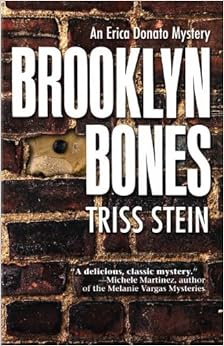
Brooklyn Bones

I don't think I've read a book by someone I've known, however meager the acquaintance, excepting academic books.  But here's one. I have to say, I expect the worst from genre mystery books these days, and Brooklyn Bones is solid.  It avoids a lot of traps.

Erica is our main character, and she has her head on strait.  The relationship between Erica and her daughter is really sweet, even if it fraught with teenage angst, and Erica always acts for her daughter first.  Really the only criticism I have is that the mystery seems to coalesce around Erica and then resolve itself without much action by Erica herself.  I'm not even sure that's a criticism.  It's just different from other mysteries.  But that's how I think Brooklyn Bones stays true - a lot of books veer off course because the hero/heroine has to take nonsensical or contrived actions to move the plot forward, and here Stein finds other ways to get to the end.  

This is definitely not hard-boiled, or even much of a thriller, per se.  But it is a nice, quick read of the cozy variety.

Final call: 

Friday, October 2, 2015

The Years of Rice and Salt

Somehow, I read a synopsis of this book somewhere, and bought it, and read the back of it, and still managed to not realize what the book was about!

I thought it looked at how life in Africa might have proceeded if European colonization had not occurred.  And yes, that is a part of it, albeit a very small part.  I missed the whole let's rewrite global history as if the Plague breakouts in the 1300s had killed almost everyone Western Europe, instead of only one third of them.  And I definitely had no idea about the strong Buddhist bent to the plot.  Not that any of that is a bad thing, but I rarely go into a book so off course as to what I was about to read!  

This one lies pretty solidly in that grand science fiction tradition of using alternate worlds and/or histories to question how society operates.  The author is compared to James Michener, too, since both have written epic fictionalized histories that follow generations (not quite generations in this case, but the effect is similar). I realized that it's been quite a while since I've read something in either of those veins.

So, this one was hot and cold for me.  There were parts that were frankly just beautiful, but more and bigger parts were a slog.  I had 15 pages left last night to finish this entire 700+ page book and couldn't do it.  That, like, never happens.  Some of the issue comes from the difficulties of covering so much time relatively quickly - the pace gets very uneven.  Some of it comes from the extended discussions, which were really mini-lectures, on the fabric of religion and civilization, although actually many times those were interesting to me.  

There are 10 books, I most liked Awake to Emptiness and The Widow Kang.  For a long time I thought the book's title had no specific meaning, but Widow Kang has a wonderful explanation.  The discussion of reincarnation in the last few pages of the book is both amazing and wickedly clever.     

Maybe most troubling is that I'm not sure what the big picture is.  The book seems to make judgments about particular religions/civilizations, but some of them don't seem correct, even within the context of the book.  But I think I would need more time than I'm willing to commit to untangle everything. 

Final call:
I wouldn't say that this book has broad appeal, but it's also pretty approachable.  If you feel like walking on the philosophical wild side, give it a go.