Monday, March 24, 2014

Finally, time for Middle Creek

The last two or three years, it seems like the big push of snow goose migration has arrived right around the end of February.  After this emphatic winter, the largest numbers were at Middle Creek over the last week to ten days.  Only three weeks behind!

My husband and I went to Middle Creek on the 15th.  99% of the surface water was frozen, but 60,000 snow geese and at least 5,000 tundra swans didn't seem to care.  Their biological urge is to move north, ice or no ice.  


One of the best parts of going to Middle Creek is getting to see a lift-off.  Tens of thousands of geese rising at once is like nothing else; it is a sonic experience as much as anything.  In the video, the flock was frightened by a bald eagle making a pass.

One week later, we went back with my parents.  The amount of ice that had thawed in seven days was incredible.  The number of birds was down, though.  Probably around 10,000 snows and 2,000 tundras.  We still managed to track down a flock grazing. 


These tundra swans were striking a pose, and I'm not sure if there is a reason behind what they're doing or not.  When we moved to this area, tundra swans flew over our house pretty regularly in late winter, going from the river to farm fields and vice versa.  Then, for the last few years, we didn't really see them.  One of the few benefits of this wacky winter is that the tundra swans used the river again, probably because parts of it were open almost all winter.


 The nice part about the thaw was that migrating ducks could finally use the small ponds in the park.  One of the most common this last Sunday was ring-necked ducks.  I am sure there were over 100 present, which is great for a duck that isn't all that common.


The pond by the visitor's center had a good two dozen ring-neckeds, a pair of shovelers, four hooded mergansers, six bufflehead, a couple of wigeon, and a dozen or so gadwall.  Not to mention a handful of Canada geese and three great-blue herons visiting from their nearby rookery.  Not a bad mix!

Sunday, March 16, 2014

Illuminating astrology: a 2014 Challenge extra

I don't own this book, so it wasn't on my original challenge list.  But I heard about it, became intrigued, and found out it was available through the library.  Once I saw it compared to Cloud Atlas, I couldn't resist.


Besides winning the Man Booker, you will hear two things about The Luminaries:  the author is young, and the book is long.  However, after reading Jonathan Strange & Mr. Norrell I don't know if I'll ever think of any other book as long.  I got through it in about a week, so definitely not ridiculous.   

This is one of those books where you can read the back cover and inner flap and still not really know what you are getting into.  There's a unique astrological structure that quite literally drives the plot.  The action is beyond intricate, and it's not always immediately clear what the heck happened.  Then there's a somewhat unexpected bit of the supernatural that also complicates matters.

In any case, the more I think about the book, the more I like it.  The meaning of the title becomes clear, and near the end you realize you had no idea that the entire plot (the zodiac and the planets) swings at every point around three people (the sun, the moon, and the earth).  Finding and reading most of this discussion thread really helped clue me in to the finesse in the astrological titles and other hidden gems in the text.

So was it like Cloud Atlas?  Eh.  In terms of non-linear storytelling and a unique structure.  And, briefly, a South Seas setting.  But otherwise, no.  Cloud Atlas is actually pretty easy to "get."  Mitchell borders on too obvious with the clues to his game - thank you, comet birthmark.  Catton buries hers so deeply that you might even need to read it again (!) to put everything together.  Yeah, no.  Not this year, anyway  :)

   Final call:


(and a half, maybe)


Consider long and hard before you decide to read this.  Like Dickens?  Like subtlety?  Have a big chunk of time on your hands?  Then go for it!

Saturday, March 15, 2014

Auction action

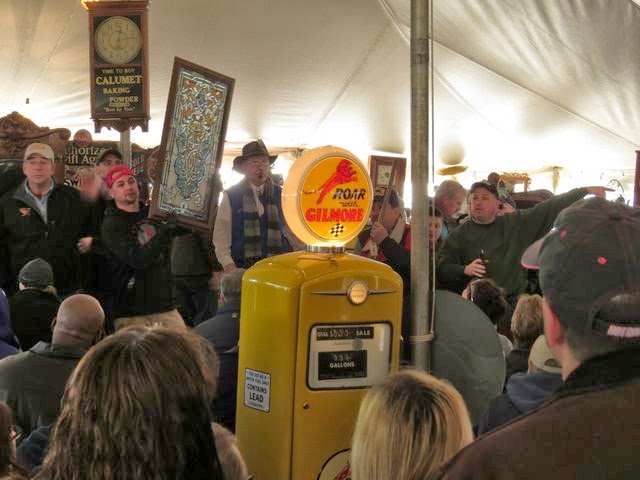
We were at Middle Creek this morning for sunrise, and those pictures will be coming soon.  But first, on the way home, we stopped at Penryn Fire Company's mud sale.  People donate pretty much every kind of goods imaginable and then they're auctioned off to benefit the fire company, and in this case, also a local Amish school.

Despite growing up in PA, I'd never heard of mud sales until moving here, and this is the first one I've checked out.  I was picturing something ... much smaller in scale!  At any given time probably 10 different auctions were going on.  Plus food, oh man, the food.  What a month to decide to eat healthy.


The antiques tent, where the entry was marked by a large cow figurine.  Would love to know what it went for (and where it came from!).  Competition for antiques was intense.


Some categories had their own tents, and others were on flat-bed trailers outside.  If you look closely at this next shot, you can see vees of snow geese in the air.  Penryn is not far from Middle Creek!


Here was where the plant auction was set up.  They had some fantastic stuff - weeping pussy willows, red twig dogwoods, all kinds of things.  There's a reason we didn't get a call number; I probably would've have impulse bought those dogwoods (couldn't afford not to - $7 a piece) if we had one.  lol.


And when I said they had everything, I did mean everything.  Here's their outhouse selection!


Friday, March 14, 2014

A return to Alexander's empire

You'd have no reason to know it yet, from this blog, but I really enjoy Gail Carriger as an author.  She writes laugh-out-loud funny steampunk books with big hearts. She blogs, too.  And not too long ago, she gave out a couple of recommendations for historical fiction that isn't as well known as it should be. Judith Tarr's  Lord of the Two Lands was one.  


Lord of the Two Lands follows Alexander the Great in Egypt.  Gail highlighted a small excerpt from the text that involved a cat. And it's available as a pretty inexpensive ebook So, I was triply sold.  

This book covers a period of time that Mary Renault's books gloss over, so it's a good fit with my recent reading.  This is Alexander, after Issus, in Phoenicia and Egypt.  The main character is an Egyptian priestess named Meriamon, whose gods-given mission is to bring Alexander to Egypt after a vision reveals that he will free Egypt from its hated Persian conquerors and become Pharaoh.  

From a historic perspective, this is of course the founding of the Greek Ptolemaic dynasty in Egypt, which ends three hundred years later with Cleopatra's dramatic and ill-fated fighting with Augustus's Rome.  So it's a fascinating period of history.  There are fine descriptions of ancient warfare and military logistics.  Gods of all sorts are real and magic exists on different levels., but it's not overdone.

File:Siwaoasis.JPG
Siwah Oasis, Site of Ancient Oracle of Amon.  Photo courtesy of user:heksamarre, Wikimedia Commons

I had heard there was romance, and wondered how that would work with Alexander, who was historically, ummm, not that into women.  I guess I should have known - he wasn't the focus.  Meriamon's relationship with one of Alexander's companions is handled nicely, as are her interactions with Alexander.  

   Final call:


This is an entertaining, easy read that's also got a good head on its shoulders.  If you like historical fiction, put it on your list.     

Monday, March 10, 2014

Rednecks down at the river

Red-necked grebes, that is!  With the harsh winter and the freeze-over of the Great Lakes, quite a few of these guys have been hanging out on the river.  Today, a lucky confluence of good weather, lengthier daylight hours, and tolerant grebes helped me get my best pictures to date.


There were probably six or eight grebes stretched out along the half-mile of river I covered.  They are divers, and tend to fish relatively close to shore.  If they catch on that you are interested in them, though, they'll quickly move up or down the current and away from you.


I was able to use some trees for cover, and move closer while the grebes themselves were underwater.  They came quite close, when I wasn't moving around much.


These grebes have a pretty neat hair-do, but it took me a while to get one showing it off properly.  Well, up above, one is just up from a dive and in need of some hair gel. This one had a little more orderly 'do:


The long, heavy yellow-and-black bill helps to distinguish red-necks from other grebes in their winter plumage, although, by this time, most have transitioned at least partly to breeding plumage, evidenced by their red necks.

Spending an hour or so watching these guys ply their trade was a great way to celebrate daylight savings time and the arrival of decent temperatures, finally.

Other species seen/heard:  subadult bald eagle, thousands of ring-billed gulls, four hooded mergansers, hundreds of Canada geese, ten tundra swans, mallards, killdeer, carolina wrens, fish crows, turkey vultures, and starlings. 


Wednesday, March 5, 2014

Quote Storm: The Sweetness at the Bottom of the Pie

Flavia is one of a kind.  These are a few of my favorite glimpses into her world.

...

(I'm with you on this one, Flavia!)

As I stood outside in Cow Lane, it occurred to me that Heaven must be a place where the library is open twenty-four hours a day, seven days a week.

...

The de Luce children love squabbling with each other.  Flavia, in church with her older sister:

Now, glancing over at Feely as she knelt with her eyes closed, her fingertips touching and pointed to Heaven, and her lips shaping soft words of devotion, I had to pinch myself to keep in mind that I was sitting next to the Devil's Hairball.

...

On poisons:

Although I have to admit that I have a soft spot for cyanide - when it comes to speed, it is right up there with the best of them.  If poisons were ponies, I'd put my money on cyanide.

...

A simile that really caught my imagination.  This is Flavia, catching the scent of her long-dead mother's perfume:

The scent was of small blue flowers, mountain meadows, and of ice.

A peculiar feeling passed over me - or, rather, through me, as if I were an umbrella remembering what it felt like to pop open in the rain.

...

And Flavia, describing herself and her family:

Once, when I was about nine, I had kept a diary about what it was like to be a de Luce, or at least what it was like to be this particular de Luce.  I thought a great deal about how I felt and finally came to the conclusion that being Flavia de Luce was like being a sublimate: like the black crystal residue that is left on the cold glass of a test tube by the violet fumes of iodine. 

As I have said, there is something lacking in the de Luces: some chemical bond, or lack of it, that ties their tongues whenever they are threatened by affection.  It is as unlikely that one de Luce would ever tell another that she loved her as it is that one peak in the Himalayas would bend over and whisper sweet nothings to an adjacent crag.

...


Saturday, March 1, 2014

Corny titles du jour

I told you I was going to read some fluff, and so I did.  The Sweetness at the Bottom of the Pie by Alan Bradley was my choice.  I actually bought this book and the second one in this series when Borders was going out of business.  So, I've had them for a while.


If you're unfamiliar with this series, Alan Bradley is a 70-year old first time author who never visited Britain prior to publishing this book, which is set in a small English village in the 1950s.  Which kind of blows my mind.  I've never been to England to check, but since he's won all kinds of awards, I assume the setting is more or less true to reality.  

The main character is an 11-year old girl named Flavia de Luce.  She's independent, precociously intelligent, and in love with chemistry.  One of those kids whose intellect has far outstripped her social development.  She comes off with several totally hair raising commentaries, it's part of the charm and comedy of Flavia.

These are mysteries.  A dead bird and a stamp are found on a doorstep.  A man who argues with her father in the middle of the night turns up dead in the garden.  Flavia rides her bike. A lot.  I won't spoil the solution, but the mystery is fairly satisfying.  And I respect that Flavia, for a while at least, doesn't rule out her father as a suspect.

The overarching themes are of England in the 50s - still reeling from WWII, a generation of men lost or wounded, and much of the old aristocracy, including Flavia's family, running out of money.

There were a few things I didn't care for, but not many.  We get some very painful Asian stereotypes, but I suppose they're a facet of the time period, unfortunately.  And the de Luces are an extremely eccentric family, odd to the point of incredulity.  One of the more amusing annoyances is Flavia's epiphanies.  At least six times, she says she sees it all, sees the whole pattern.  It all makes sense.  And then she announces something completely anticlimactic.

I'll probably be reading the second in the series, The Weed that Strings the Hangman's Bag, soon.

   Final call:


This is really good stuff, for fluff.  There are quite a few plot points that seem fantastical, but Flavia's characterization is spot on.  Nailing down how preteens think is hard!  I laughed out loud a couple of times, too.